
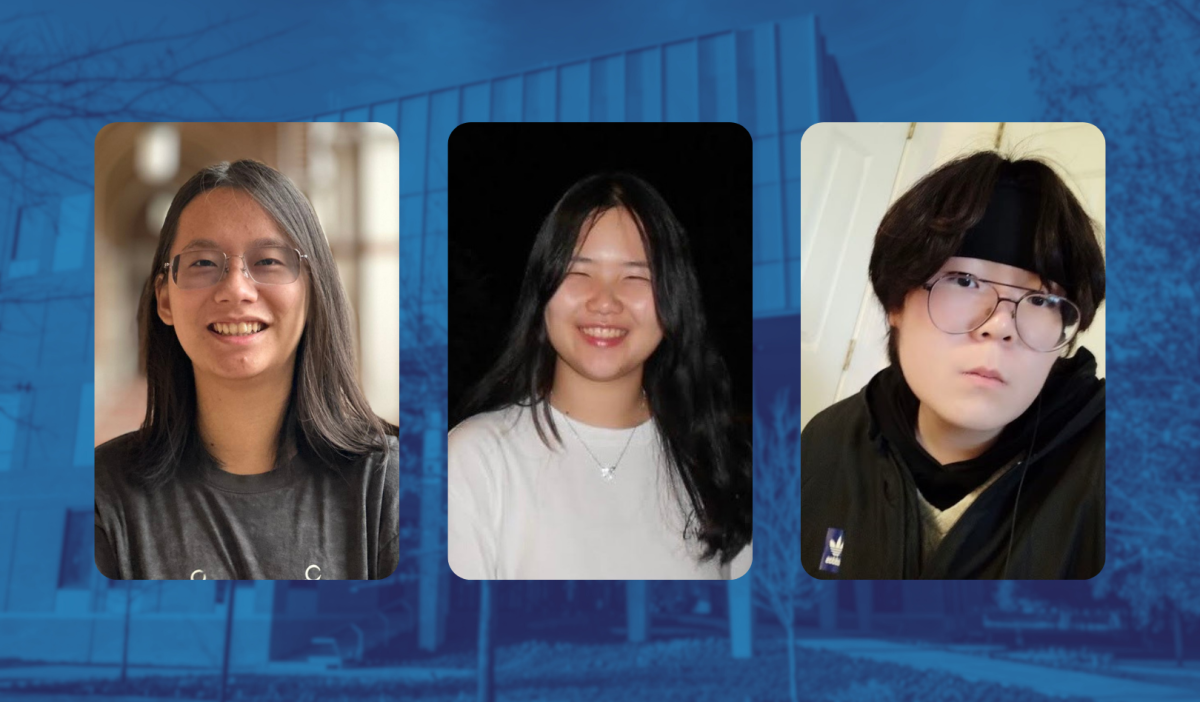
Rice University’s industrial-organizational (I-O) psychology program is an institutional leader in the study of work and the workplace. Spearheaded by I-O psychologist Tianjun Sun, assistant professor of psychological sciences, the SMART (Selection, Methodologies, & Assessment Research via Technology) lab uses advanced quantitative methods and emerging technologies to study individual differences in work-related settings. Through hands-on research and close mentorship, the lab prepares students to conduct rigorous, high-quality work at the intersection of psychology, data science, and real-world application. Three SMART lab students, with recent notable accomplishments, shared their experiences in the lab, what’s in store for the future, and advice for their peers.
Junior Xinyi Li will present her first-author research at a highly rated symposium during the Society for Industrial and Organizational Psychology (SIOP) annual conference in New Orleans in April. Sophomore Jenny In, similarly, will present a first-author poster of a full paper at SIOP. It is a considerable accomplishment for an undergraduate student to present at this high-caliber conference.
Please provide a brief overview of the research you’ll be presenting at SIOP.
XL: I will be presenting as part of a symposium titled Application of AI in Psychological Assessment and Personnel Selection. Our research is a meta-analytic review of 56 studies examining the convergent validity of natural language processing (NLP) models in predicting Big Five personality traits compared to the traditional Big Five measurements. We also explored potential moderators of NLP prediction accuracy, including differences in text data, personality scales, and modeling approaches. Overall, our findings provide a comprehensive understanding of the effectiveness of NLP in personality assessment.
JI: Research has shown that "adaptive" personality – higher conscientiousness, emotional stability, agreeableness, and extraversion – is associated with positive work outcomes, such as better job satisfaction. My research examines the relationship between "changes" in such personality and changes in work outcomes. We also see how personality-job fit (the degree to which one's personality fits their job) moderates this relationship. For example, we expected to find that an introverted person who adapts to sales work might experience a greater increase in job satisfaction than someone who was extroverted to begin with.
How did your experience in the SMART lab help prepare you to present as a first author at a premier conference like SIOP, and what was the most rewarding (or challenging) part of reaching the milestone?
XL: This project was passed down within the lab, and I could not have achieved this without the mentorship of Dr. Sun and the support of the amazing graduate students in the lab, who patiently guided me through the stages of conducting a meta-analysis. The most challenging part of the process was navigating the wide range of NLP and statistical methods used across studies published in different disciplines. Engaging deeply with this literature helped me understand how NLP-based approaches for personality assessment have evolved and strengthened my passion for applying computational and statistical methods to psychology research.
JI: My lab was like a safe place where I could test out my ideas and practice my skills. I was encouraged to try it out, from developing an idea to drafting a report, and it was helpful to know that I can always ask for help or guidance. I will also have an opportunity to practice my presentation soon in front of other SMARTies! Though it was challenging to come up with a solid idea and run complicated analysis, with tremendous help from my mentors, I was able to produce good work.
What are your next steps after you present your research?
XL: Since the study is complete, after presenting in SIOP, my next step would be to support the submission of this meta-analysis to a top-tier journal. Beyond this project, I desire to pursue continuing research at the intersection of psychology, machine learning, and statistics in organizational settings, through ongoing work in the SMART lab and my honor thesis.
JI: We will improve this project by using specific job titles when calculating personality-job fit, and we are currently in the process of getting the necessary data for it. After that, we plan to submit it to an academic journal. We are also working on another project on personality-job fit, and I'm excited to see how it goes!
What advice would you give to other undergraduate students who are interested in getting involved in high-level research but might be intimidated by the scale of national conferences?
XL: I think finding a lab that fits your academic interests and working style is very important. I really value the collaboration and discussion-focused environment in SMART lab, as our lab meetings focus on discussing articles, sharing ideas and giving feedback on each other's work. I also encourage students to stay open and try different types of projects. I was initially not the biggest fan of meta-analyses, but joining the project helped me learn so much and landed me the opportunity to present at SIOP! Finally, don't hesitate to talk to grad students and especially your PI, since they are the experts in the field, they would always have something that matches your interests or desired skills to develop.
JI: Don't let the final product intimidate you! Participating in undergraduate research itself is a great experience, and I think being interested and getting started are the most important parts. Begin with small steps and don't be shy to reach out to any professor whose work interests you. In my experience, Rice professors are very open to supporting your research and helping your growth.
Pengda Wang, a third-year PhD student, recently completed a PhD AI residency/internship at Midjourney, contributing cutting-edge psychometric AI knowledge to the rapidly growing AI industry.
Please provide a brief overview of the work you contributed to during your Midjourney residency.
PW: I am unable to disclose many details, but all of the research I conducted there was applied in nature. The overarching goal of my work involved developing new methods for measuring and predicting psychological and behavioral traits (including but not limited to personality, values, vocational interests, humor, habits, and workplace behavior) for both users and employees. The methodologies I employed spanned from traditional statistical techniques such as ANOVAs, regressions, multilevel modeling, factor analysis, and structural equation modeling to modern machine learning approaches, including elastic-net, tree-based methods, high-dimensional space representation, large language models, multi-agent systems, and reinforcement learning algorithms such as PPO, DPO, and GRPO.
How did your experience in the SMART lab help prepare you to complete a high-level AI residency as a PhD student, and what was the most rewarding (or challenging) part of reaching the milestone?
PW: My experience in the SMART lab was important in laying the technical and conceptual foundation necessary for success in the Midjourney internship program. The lab fostered a rigorous yet exploratory environment that encouraged me to apply computational and data-driven approaches to the study of psychological phenomena. I was introduced early on to advanced modeling techniques, interdisciplinary collaboration, and the iterative process of building and refining assessment systems, all of which directly informed my work during the internship.
The most rewarding part of reaching this milestone was realizing that the skills I developed in an academic research setting could be applied to real-world systems with broad impact. However, the most challenging aspect was overcoming the steep learning curve involved in integrating machine learning techniques with psychometric models in a way that was both scientifically valid and practically useful. Nevertheless, this challenge was also the most intellectually satisfying part of the experience.
What are your next steps after your PhD?
PW: After completing my PhD, I plan to continue working at the intersection of psychological science and machine learning. My primary research interests are centered around leveraging innovative technologies to enhance psychometric assessments and employee selection. I am particularly interested in how personality and individual differences can be more accurately and fairly assessed through the integration of advanced quantitative methods. I am also committed to advancing open science through the adoption of novel methodologies. My aim is to become an I-O psychologist who is an expert in quantitative analysis, with a keen focus on harnessing machine learning to elevate the accuracy and fairness of psychological measurement and personnel selection systems. I am especially interested in positions that allow me to bridge research and application, no matter if it is in industry or academia.
What advice would you give to fellow graduate students who want to bridge the gap between lab research and the tech world?
PW: Start by identifying the real-world relevance of your research, and do not be afraid to translate your academic work into terms that resonate with industry. Learn how to communicate your methods and findings to non-academic audiences; being able to explain why your work matters is just as important as how it works.
Also, get comfortable with ambiguity and fast iteration. The tech world often moves at a different pace than academia, and problems may be less defined, but that is where creativity and impact can thrive. Finally, invest in developing technical fluency (e.g., coding, machine learning, or data infrastructure skills), even if they are not central to your research. They will expand your toolbox and open more doors when bridging the two worlds.