
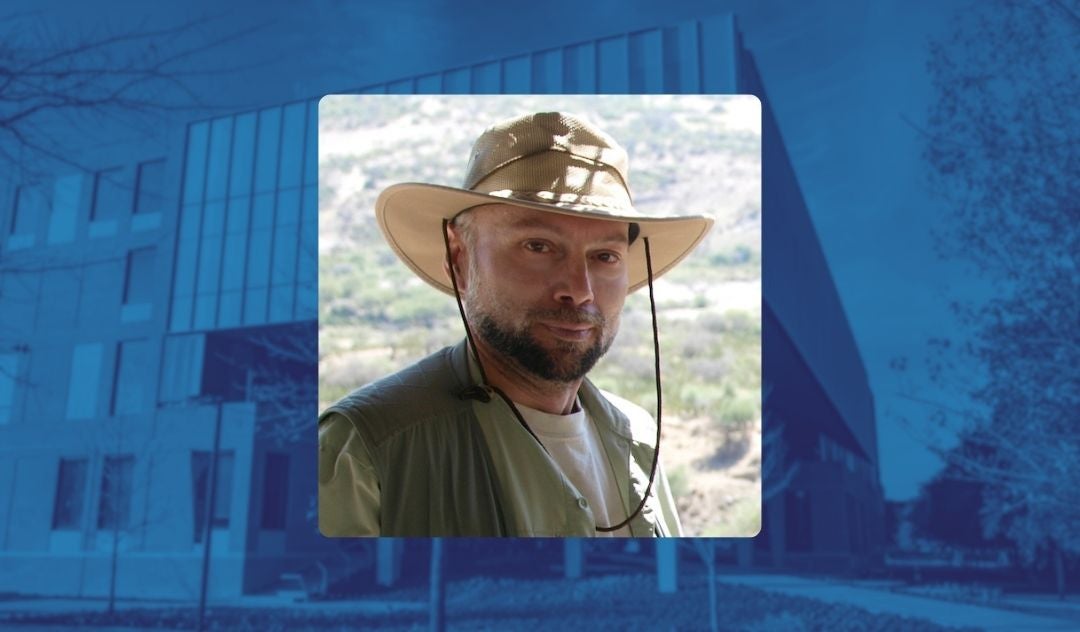
Leading experts in Rice University’s School of Social Sciences are exploring pioneering methods to push the boundaries of research. This series features Rice social scientists who are utilizing new and innovative uses of artificial intelligence (AI) to enhance scholarship. Today’s featured faculty is Manuel Domínguez-Rodrigo, professor in the Department of Anthropology.
Archaeologist Manuel Domínguez-Rodrigo has spent over 30 years trying to unlock the origins of humans and their evolution, focusing on the period between three and two million years ago.
“That's the important period because that's when our genus – the genus Homo – evolved,” said Domínguez-Rodrigo. “And that's where the basic innovations of everything that we call ‘human’ appeared.”
For the past several decades, Domínguez-Rodrigo has been working throughout Africa to understand what happened during that precise period of time. He has also found a home in Rice’s Department of Anthropology, a department known for its strength in African archaeological teaching and research.
Domínguez-Rodrigo’s research involves investigating archaeological sites that appeared during the targeted time period, using taphonomy – studying human and animal remains – to understand how the sites were formed.
“These are special places in the landscape that early humans started using for the first time, when they started behaving differently and doing things that are familiar with things we do today,” said Domínguez-Rodrigo. “To understand all of this, we try to reconstruct how humans were obtaining food, whether they were hunting or scavenging those animals, which leads us to explore what other carnivores were doing with those assemblages.”
In 2016, Domínguez-Rodrigo reached a turning point in his career.
"For the previous 20-plus years, experts who were in front of the same evidence would often have different interpretations, and I realized that we were creating narratives that were not scientifically supported,” said Domínguez-Rodrigo. “When looking at bones, for example, some people would identify a mark as a cut mark made with stone tools, while others would identify it as a trampling mark or a carnivore mark.”
Domínguez-Rodrigo realized that, although well intentioned, the research could be highly subjective, and he made it his mission to move the field toward a more scientific approach. Around this time, the use of AI was emerging in other fields, such as medicine.
“I thought, if this is working for something as serious as medicine, it also has the potential to improve our field,” said Domínguez-Rodrigo.
Making the transition required a “complete transformation.” Domínguez-Rodrigo dedicated himself to learning a brand-new set of coding, methods, and techniques. He reached out to a group of expert colleagues to identify fossil marks, and he compared their accuracy with AI. The highest rate of identification from the experts was 62%, whereas AI was more than 90% accurate, results that convinced Domínguez-Rodrigo this was the new way forward.
Shortly after, Domínguez-Rodrigo and fellow archaeologists in Madrid founded the Institute of Evolution in Africa, where they have been pioneering the use of AI in paleontology, archaeology, and paleoanthropology.
“We were constantly surprised by what AI could do,” said Domínguez-Rodrigo. “It could look at tooth marks made by different kinds of carnivores and tell you, not only is a tooth mark made by a carnivore, but more specifically, it is made by a lion, or a hyena, or a leopard – something a human brain could not do.”
The sharpened analysis has allowed archaeologists to explore deeper questions about the 90% of ancient human remains that contain tooth marks.
"The tooth marks could represent humans being prey for other carnivores, or they could represent them being scavenged by carnivores because when they were alive, they were powerful enough that no carnivore would dare to hunt them,” said Domínguez-Rodrigo. “Now with AI, we can look at those bones and understand exactly how they were modified.”
Aligned with Rice’s Momentous strategic plan, Domínguez-Rodrigo has brought the Institute of Evolution in Africa’s framework to the university. In collaboration with Huixia Judy Wang, chair of the Department of Statistics, Domínguez-Rodrigo will be developing a new generation of models that will address AI and three-dimensional objects, with the goal of identifying the earliest bipedal humans.
This year, Domínguez-Rodrigo is teaching a new undergraduate course, Deep Evolution: Using Artificial Intelligence to Decode Early Human Origins.
"Many people see the dark side of AI, instead of the positive impact it might have,” said Domínguez-Rodrigo. "It's fair to criticize it. We are among the first ones to see when AI should or should not be used. But to do that, we have to really understand what AI does and how it performs. I'm trying to help students take their fears away by learning the basics of these AI methods.”
During the course, students will utilize AI tools to analyze fossils, reconstruct anatomies, and understand the way ancient humans moved and lived.
For Domínguez-Rodrigo, social scientists play an important role in addressing the issues and possibilities of AI.
"There is a necessity to be more critical about what uses should be promoted versus what uses should be taken with caution," said Domínguez-Rodrigo. “As social scientists, we have the privilege of being able to use a broader scope to explore how AI affects human society.”