
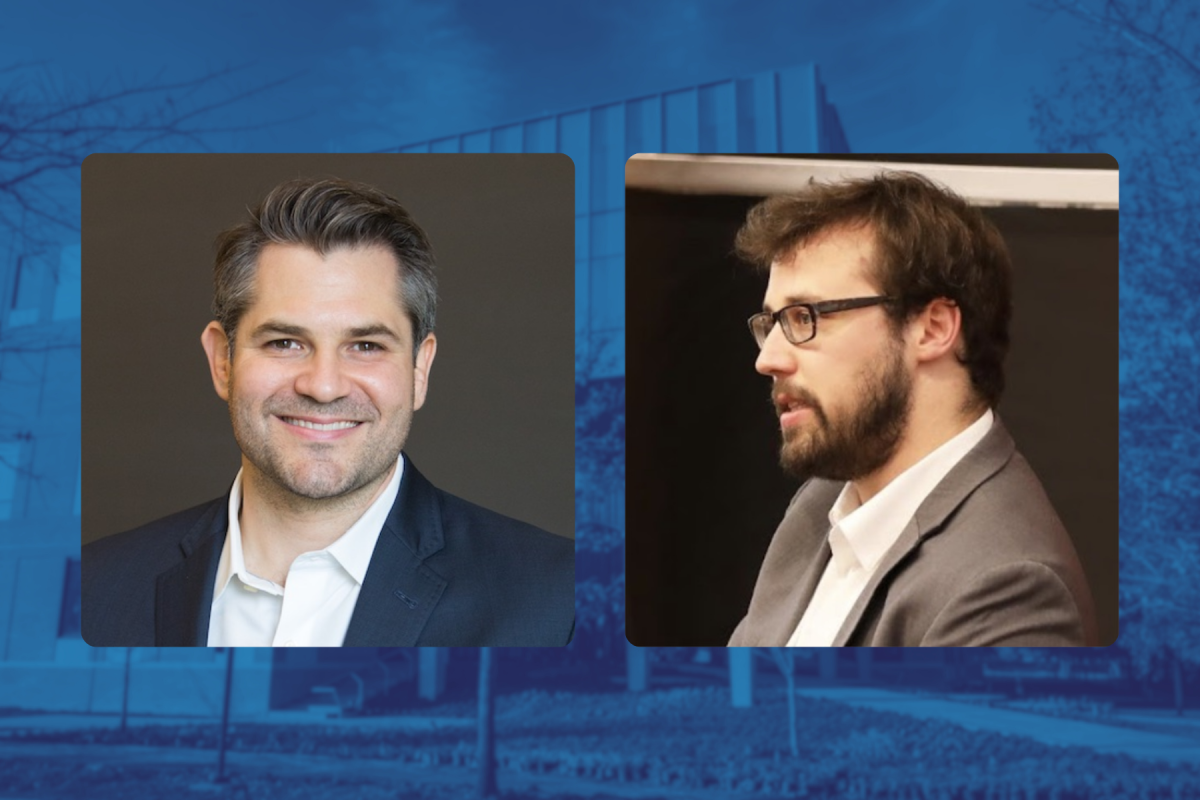
Leading experts in Rice University’s School of Social Sciences are exploring pioneering methods to push the boundaries of research. This series features Rice social scientists who are utilizing new and innovative uses of artificial intelligence (AI) to enhance scholarship. Today’s featured faculty are Zach Bethune, L. Douglas Lee Associate Professor of Macroeconomics, and Guillaume Pouliot, associate professor of economics.
Addressing how different individual and group behaviors impact the life cycle of goods and services, the field of economics has a broad reach in tackling local and global issues and in impacting related policies.
Zach Bethune, who joined the Rice University Department of Economics in 2022, centers his research on macroeconomics and finance, specifically monetary policy and decentralized asset markets.
“Macroeconomists previously thought, for example, about the effect of monetary policy on the average household,” said Bethune. “Starting in the 1990s, macroeconomists began to reshape their thinking from looking at average effects to heterogeneous effects, understanding that monetary policy affects households differently. This is important because the average may not be sufficient if monetary policy helps some and hurts others; we need to think about how policy today and tomorrow affects the whole distribution of households across space, time, wealth, and income, among other variables, which requires more complex modeling – this is where artificial intelligence is pushing the boundaries of what we can study.”
Having recently completed his first year at Rice’s Department of Economics, Guillaume Pouliot specializes in econometrics.
“Many applied researchers have the data and the questions they want to address, but they need the algorithm that will estimate the results correctly, including estimates of uncertainty,” said Pouliot. “If a researcher wants to know if a policy helped create 10,000 jobs, is the margin of error plus or minus 100 jobs or is it plus or minus 9,000 jobs? I'm interested in providing tools that extract the same kind of causal conclusions you would get from experimental data, but for observational data, which is more challenging.”
Both Bethune and Pouliot are pushing the boundaries of their research by incorporating AI to enhance processes.
In Bethune’s case, macroeconomists use computational methods and track how distributions change over time. Bethune has found that AI models, such as large language models (LLMs) or advanced computation, are opening up the possibility of studying richer models. Bethune also uses AI to support other aspects of the research process, such as cleaning data, code generation, and editing.
Similarly, Pouliot has found AI to be a useful tool in refining complicated models, specifically those that generate synthetic data. To determine if a synthetic dataset is close to a true dataset, he feeds both sets to a neural net and asks it if it can distinguish between the two. The answer will determine whether the parameters of the model for the synthetic dataset are realistic or if they need to be adjusted.
“It has been surprising how well AI actually works for this purpose when we can get it to work; however, it can be challenging to get to that point,” said Pouliot. “It is also quite astounding how well tools like LLMs function in terms of research assistance.”
Bethune agreed, observing, “People have been saying AI will progress incredibly fast, but that’s hard to grasp until you’ve used it in your own projects. Many tools are typically designed to be good at one thing. This is a tool that is broad-based enough that it can be used alongside every dimension of a research project.”
“It’s incredible how good AI is at doing what I'm particularly specialized in, which is true for other fields as well,” remarked Pouliot, who incorporates AI during the later phases of the research process. “I try to push using it out as far as possible because otherwise it's feeding you its ideas, which I have found worsens the early research process, and it requires true discipline to keep doing the thinking yourself.”
Although there are benefits to using AI throughout the research process, Bethune asserted the irreplaceability of the researcher.
“The researcher needs to come up with the idea, figure out the right model, the methodology, the approach, and the appropriate data,” said Bethune. “Great skill is required in the use of AI – in how you prompt it and provide guardrails. You still need to check its work, which requires AI education and literacy. For now, our own human capital isn’t replaced by AI, it’s a valuable input.”
In terms of teaching, Bethune noted that students should be expected to use AI and to be taught how to use it appropriately.
“The question that remains is, ‘How do we develop those skills that still improve their human capital and teach them something, as opposed to just using a tool to get an answer?’” said Bethune.
“For introductory classes where students really engage with the definitions for the first time, I have no problem making the case for classwork to be completed without the use of AI,” said Pouliot. “Getting a computer to clean data, as an example, takes two minutes, whereas doing it yourself can take two days, so it can feel absurd to do it yourself. But if you've never gone through the process yourself, you don't know how to inspect or understand what's happening when a computer does it for you. It’s important to experience the process to build that foundational knowledge.”
Pouliot sees great value in addressing the issues and possibilities of AI from a social sciences lens, as demonstrated by an increase in grants that explore some of the most pressing questions surrounding AI and related policies.
“Economists are going to have a lot to say because one of the main concerns addresses what will happen from a social inequality standpoint,” said Pouliot. “It doesn't seem like the policy will have time to anticipate the changes. So, there is a lot of economic research needed to move policy.”
Bethune elaborated, saying, “I think every lens of economics addresses concerns about AI, such as the substitutability of human capital in light of this new technology and what it will look like in the next five, 10, 15 years. And that's going to dictate a lot about how labor is valued, which then feeds into inequality and informs what policy should address.”