
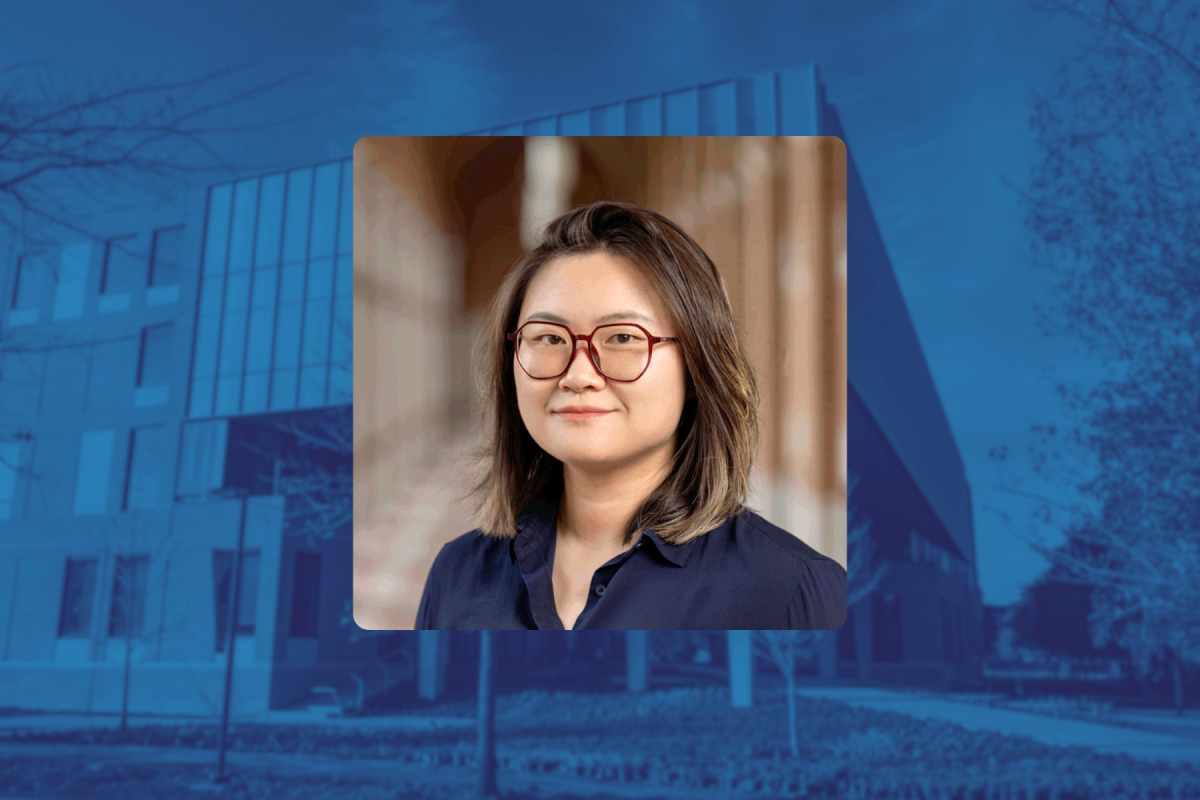
Leading experts in Rice University’s School of Social Sciences are exploring pioneering methods to push the boundaries of research. This series features Rice social scientists who are utilizing new and innovative uses of artificial intelligence (AI) to enhance scholarship. Today’s featured faculty is Tianjun Sun, assistant professor of psychological sciences.
In reflecting on the past two years at Rice, industrial-organizational (I-O) psychologist Tianjun Sun highlights the uniqueness of the psychological sciences department, noting a strong balance between basic and applied research. Other qualities that drew Sun to Rice University – and the world’s #1 I-O psychology program – included its culture of care, beautiful campus, and overall positive environment.
As an I-O psychologist, Sun develops computational and psychometric methods for measuring individual differences and evaluating AI-enabled assessments, with applications in personnel selection, personality, and organizational research. Rather than asking only whether AI can make predictions, Sun studies whether and how AI measures psychological characteristics in ways that are scientifically valid.
Since joining Rice, Sun has received competitive research awards supporting her work on AI-based psychological assessment and has expanded her collaborations with researchers across multiple schools, centers, institutes, and groups on campus on the responsible development of AI technologies.
“I take a methodological perspective or standpoint to study individual differences in the context of the workplace and of lifespan development,” said Sun. “This includes personality, values, interests, social behaviors, and other individual differences in a population.”
Sun uses computational and psychometric modeling, AI, and other technologies to study individual differences in relation to personnel selection or personality evaluation. She aims to determine how to improve the measurement of individual differences so they can be represented and quantified accurately and fairly.
“In addition to increasing the accuracy of measuring these seemingly abstract constructs of individual differences, I’m also exploring if we are disadvantaging groups of people by measuring these things or by using certain measurement technologies,” said Sun. “Is there some hidden bias, or are there some systematic sources of error?”
When she was in graduate school, Sun became interested in leveraging technology and complex computational systems to advance measurement in I-O psychology research. She developed AI chatbot-based narrative personality assessments that infer personality from open-ended conversations and compared them with traditional personality inventories. Using these tools, she explored how people described themselves and evaluated others’ personalities, as well as their individual perceptions of the interactions.
Sun noted that researchers can observe behaviors, but measuring the underlying traits directly is much more challenging.
“Personality itself is not directly observable, but we can observe patterns of behavior, language, and responses that provide evidence about personality,” said Sun. “Through this work, I aim to bring psychometric principles into modern AI systems so they can measure psychological constructs more accurately, transparently, and fairly.”
The measurement frameworks and evaluation methods Sun develops are intended to help researchers integrate AI into psychological assessment in scientifically rigorous and transparent ways.
More recently, Sun’s work has expanded beyond personality assessment to include AI-assisted interviewing, explainable AI, and multimodal assessment. Her research examines not only whether AI systems are accurate but also whether they align with established principles of psychological measurement, such as validity and fairness. Her work has implications for hiring, education, workforce development, and other settings in which AI is increasingly used to evaluate or support people.
Although not necessarily surprising, Sun has observed a tension between the rapid evolution of AI and the time it takes to thoughtfully research the technology and the ways people interact with it.
“Generative AI is advancing rapidly, creating an urgent need to understand how these technologies affect people and organizations. At the same time, rigorous scientific evaluation necessarily takes time, making it important for researchers to develop methods that remain informative even as the technology evolves,” said Sun. “However, while individual AI models may change quickly, the scientific questions about how people interact with these systems and how to evaluate them responsibly remain just as important.”
Sun also discussed AI literacy and its growing importance in areas such as personnel selection, which affects how traditional assessments are used to evaluate people.
“Individuals can use AI tools when they're completing knowledge tests, answering interview questions, or preparing for an interview,” said Sun. “So, can we still use traditional measurements to evaluate people?”
Sun believes education must also evolve to prepare people for a future in which humans and AI increasingly work together. Because not everyone is equally comfortable adopting AI, effective training and support will also be important.
Sun, who stays abreast of AI developments as part of her research, feels well-equipped to incorporate AI into course materials. She integrates foundational knowledge of model behavior, statistics, and psychometric principles into her teaching.
“In my classes and in my lab, I encourage a responsible and critical use of AI,” said Sun. “I encourage people to use and learn about all the available resources and to explore how they can help with day-to-day work, classwork, and research.”
Social scientists, Sun believes, play an integral role in AI research and development.
“Building better AI isn’t only an engineering problem,” Sun said. “It is also a measurement problem and a human problem. Psychology and other social sciences bring more than a century of scientific research on understanding people, developing valid assessments, and evaluating fairness, knowledge that is increasingly important as AI becomes part of everyday decision making.”