
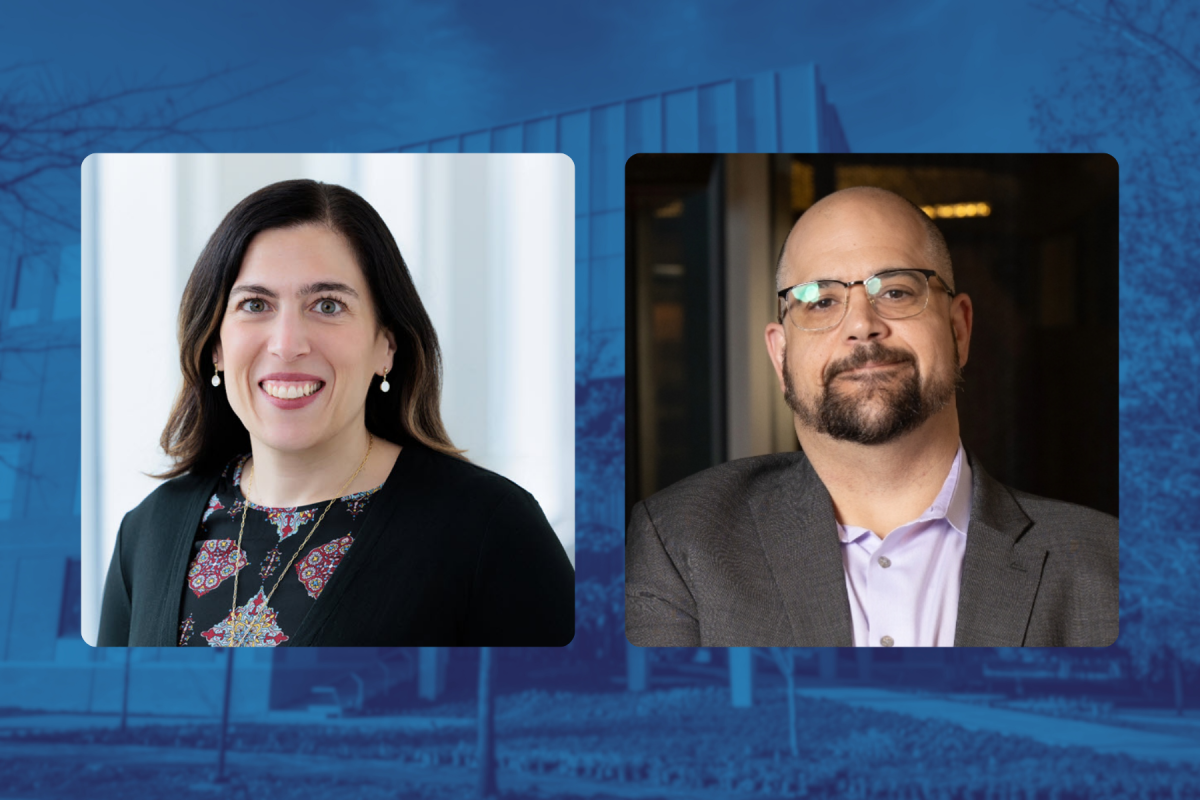
Leading experts in Rice University’s School of Social Sciences are exploring pioneering methods to push the boundaries of research. This series features Rice social scientists who are utilizing artificial intelligence (AI) in new and innovative ways to enhance scholarship. Today’s featured faculty are Elizabeth Roberto, assistant professor of sociology, and Corey Abramson, professor of sociology.
As the landscape of AI rapidly evolves, social scientists are discovering ways to incorporate AI to enhance research, while simultaneously exploring its societal impacts. Sociologists Elizabeth Roberto and Corey Abramson are pioneering AI research methods and leading efforts to engage in AI conversations throughout the Rice community.
A broad field within the social sciences, sociology welcomes a diverse range of interests and focus areas. As such, although Roberto and Abramson both utilize data science and AI in their research, they explore unique sociological questions and topics.
Roberto was first inspired to incorporate AI into her research by her intellectual curiosity and a drive to learn more.
“As a methodologist, I don't develop tools just to have another tool,” said Roberto. “I have theories I want to explore and research questions I want to answer. AI is one more resource I can draw on, one that may let me do things I couldn't before."
Roberto studies how physical infrastructure shapes residential segregation and access to opportunity for communities. She develops advanced spatial computational methods for this work, including a framework she developed with Tina Law from the University of California, Davis, that uses generative multimodal models to analyze satellite and street view imagery and identify built environment features.
“This is useful in my own work, but the applications go further, such as estimating storm damage or mapping informal settlements,” said Roberto. “I'm using AI to build computational pipelines for spatial data and image analysis that apply far beyond any one project."
As an ethnographer, Abramson spends extensive periods of time with people in real-world environments and interviews them about their experiences, studying how people navigate health, aging, and serious illness in American society. His work builds methods that scale, rather than replace, this close-up study, linking individual narratives to patterns across populations and places. Abramson and fellow researchers began with machine learning, training models on expert coding to address concrete problems in their workflows before newer generative tools arrived.
“We wanted to test what advanced computational tools could do to aggregate, check, clean, curate, and classify data. We wanted to better understand life with terminal disease, not to treat the technology as an end in itself,” said Abramson.
Abramson has found that AI offers a way to improve precision, adding another layer of checking for errors and edge cases, validating expert coding grounded in field research rather than substituting for human judgment. The models his team benchmarks are small and can run offline, which keeps sensitive data local and is efficient for the task at hand.
“People often think of AI as a way to do things faster. For me, it's about reducing error, working more systematically, and working at scales we weren't able to do before,” said Abramson. “It is not about saving time; ethnography is a time-consuming endeavor by design.”
The most surprising aspects of AI for Abramson have been how quickly the technology changes, which can be challenging for upskilling and for implementing policies, and how polarizing it can be.
“With any new tool, there are uses that are problematic. Sociology has always repurposed tools and developed novel methods to understand our world,” said Abramson. “The problem isn't always the tool but its misapplication. AI is not unproblematic, but neither is the use of statistics, so the goal is to take what is worthwhile and apply rigorously.”
As Abramson noted in a recent paper, “Qualitative Research in an Era of Artificial Intelligence” in the Annual Review of Sociology, the same tools can both help and quietly mislead; the work is to specify in advance where a method advances the analytical problem and where it does not.
Roberto has been surprised by AI’s impressive initial outputs, as well as how long it takes to reach research-caliber results.
“When we first tried it, we simply uploaded a satellite image and asked, ‘What are the built environment features in this image?’ No training, no prompt engineering, no context, and the response was surprisingly good,” said Roberto. “But the road to get from strong, first-run results to high-quality, research-caliber results is much longer, because the models and best practices are constantly changing.”
The Center for Computational Insights on Inequality and Society at Rice (CIISR), co-led by Roberto and Abramson, is an intellectual hub for computationally intensive social sciences research at Rice. One of CIISR’s core themes related to inequality and society is AI in Society. Center activities and initiatives include a speaker series and events that address a range of topics, such as Everything You’ve Wanted to Know about AI (but were afraid to ask); a wiki with a wide range of resources focused on the use of AI in social sciences; the CIISR Graduate Research Fellows program to support work on the cutting edge of computational social science; and grants awarded to students, faculty members, and postdocs to support work that is pushing the boundaries of computational social science, including AI.
To enhance AI education for students, Abramson and Roberto retooled a course on Data, Ethics, and Society that Roberto had designed and taught for the data science minor for several years. They received an Accelerating Responsible AI for Education at Rice award from Rice Digital Learning to support their AI-centered revision of the course, which encourages students to critically engage with new computing technologies.
“Some students developed applications, others wrote policy briefs, and several wrote essays critiquing AI, and the work was across the board impressive,” said Abramson.
Roberto and Abramson have been actively engaged in sharing social sciences perspectives and concerns with the AI Advisory Committee and software committee, among others. Having observed a desire to learn more about AI by their peers, The pair created a Faculty Learning Community around AI and complex social systems, supported by an award from the Accelerating Responsible AI for Education at Rice initiative. The interdisciplinary group, which meets throughout the year, is comprised of social sciences faculty who are invested in learning about AI tools and latest news and innovations in AI technology.
As evidenced by Roberto’s and Abramson’s leadership and dedication to exploring AI in research, there is real value in addressing the social complexities and the possibilities of AI.
“I think about the potential to work with greater accuracy: to improve the quality of healthcare, to provide better access to social services, and to address other societal issues we care about while mitigating downside is important,” said Abramson.
Roberto added, “The social sciences offer a critical perspective. We're trained to question a new technology rather than apply it blindly: to understand how it works and still ask whether, and how, we should use it.”