
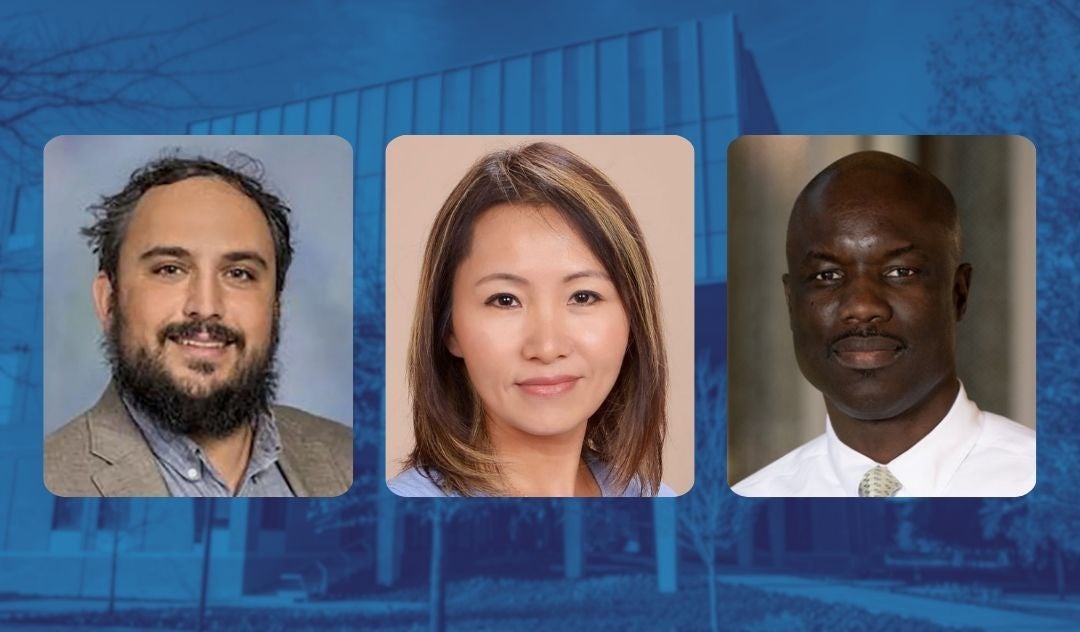
Returning for its sixth year, STaRT@Rice is the premier statistical training and research methods program for School of Social Sciences graduate students. Attendees participate in a variety of intensive workshops led by renowned Rice faculty over the course of three days.
This year, students can select from multiple new workshops, including “How Federal Research Funding Works: Tips and Strategies for Getting Funded” with Simon Fischer-Baum, associate professor of psychological sciences; “Quantile Regression for Social Sciences,” with Huixia Judy Wang, professor and department chair of statistics and William Marsh Rice Trustee Professor in Data Science; and “Demographic Detectives: Methods for Decoding Population Trends” with Kevin J.A. Thomas, Distinguished Professor of Sociology and director of the Houston Population Research Center, Demography. Wang and Thomas will be leading STaRT@Rice courses for the first time, and Fischer-Baum, who taught during STaRT@Rice’s first year, is premiering a brand-new course. The three scholars share more about their workshops and what they are looking forward to at the 2026 STaRT@Rice.
What is the new course you'll be teaching, and what can students who take your course expect to learn?
SFB: I returned to Rice this fall after four years of working in the Social, Behavioral, and Economic Sciences directorate at the U.S. National Science Foundation. Obtaining research funding is often a part of success in traditional academic settings, and the mechanisms by which that works are historically opaque to trainees and currently shifting rapidly. The goal of the course is to demystify the federal funding process, talk about all of the changes and what they mean for social science fields, and then work on how to frame a proposal based on an existing project.
HJW: My course introduces quantile regression to students and researchers in the social sciences. Quantile regression goes beyond estimating the average and allows us to understand how the effect of a predictor may vary across different parts of the outcome distribution. Participants will learn why the mean does not always tell the full story. For example, the gender wage gap may be different at the top and bottom of the earnings distribution, or a class-size reduction program may help struggling students more than advanced students. By the end of the course, participants will be able to fit and interpret quantile regression models in R, examine whether effects vary across different parts of the outcome distribution, and apply these methods to their own research. No prior background beyond basic regression is needed. The course will focus on intuition, interpretation, and hands-on practice.
KT: I will be teaching a course called “Demographic detectives: Tools for decoding population trends”. The course will give students the opportunity to learn about the tools demographers use to investigate how and why populations change. It will help them determine, for example, the relative contributions of births versus immigration flows to U.S. population growth in the past decade.
What are you looking forward to most as a STaRT@Rice instructor?
SFB: One of the best parts about working in SBE was getting to know the breadth of social science disciplines. People have such cool research questions and ways of answering them! I am excited to be back in a space where we get to talk about our ideas cutting across our disciplinary silos.
HJW: I'm most looking forward to the interdisciplinary mix of participants. Quantile regression naturally connects statistics with many areas of the social sciences, including economics, sociology, political science, education, psychology, and public policy. Researchers in these fields often study outcomes that vary greatly across individuals, such as income, educational achievement, health outcomes, or social and economic inequality. Quantile regression provides a useful way to look beyond average effects and better understand these differences. I'm especially excited to help participants think beyond average effects and ask questions such as, "Does this intervention or policy affect everyone in the same way?" I also look forward to seeing how participants apply quantile regression to questions and data from their own research.
KT: I am looking forward to helping students develop new ways of understanding the dynamics of population change. I hope to teach them some of the basic methods used in demographic analysis. This process will use real-life data to illustrate how demographic analysis can provide answers to questions that affect our daily lives.
What would you tell someone who is considering participating in the 2026 STaRT@Rice?
SFB: It’s a real opportunity and a rare one - to expand your skill set and to get to know folks from across the school. There is so much insight to soak up, not just from the fantastic instructors but from the other participants. Be open to leaving with different ideas about what kinds of inquiry are possible than you entered with.
HJW: I would tell them to come with an open mind, their laptop, and possibly their own data. You don't need to be a statistician to get a lot out of STaRT@Rice. The short-course format is a great way to learn a new method and quickly see how it can be applied to your own research, without the commitment of a semester-long course. If you've ever wondered whether your data has more to tell you than what you can learn from ordinary regression and average effects, come to my short course, “Beyond the Average: Quantile Regression for Social Sciences,” and find out.
KT: Be open to learning new things. Look forward to learning from instructors who are among the leading scholars in their fields. You would leave with an increased understanding of various methods used to study social phenomena. This will help to provide a foundation for a more in-depth study of social statistics in graduate school.
This year’s STaRT@Rice program will be held on October 2-4, 2026 in Kraft Hall. Registration is open through September 18. Current Rice Social Sciences students are only required to pay the $25 registration fee, and the $150 participation fee is waived. For questions, contact start@rice.edu.